

The WNBA’s CBA Explained: How a New Deal Shapes the Draft and WNBA Contracts
This post may contain affiliate links. Please read the disclosure policy.
If you’ve read our guide on rookie contracts, you know the specific rules that govern a player’s first years in the WNBA.
But those rules were built for a different era, and with the league experiencing a seismic boom in revenue and popularity, a new deal is being negotiated that could redefine the future for every WNBA draftee and define the league for the next decade.
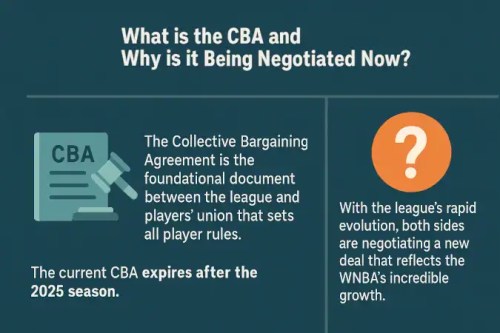
What is the CBA and Why is it Being Negotiated Now?
The Collective Bargaining Agreement is the foundational document agreed upon by the league and the players’ union (WNBPA). It governs all aspects of the player experience, setting the rules for everything from the rookie salary scale and player contract structures to benefits and travel standards.
The current CBA, which was celebrated as groundbreaking in 2020, expires after the 2025 season. While that deal secured major gains in pay and benefits, the league’s rapid evolution means both sides are back at the table to negotiate a new contract that reflects the WNBA’s incredible growth.
⭐ WNBA Expansion: Essential Fan Resources
The league is growing! Here’s how you can rep the newest WNBA teams from day one.


Watch from Home
Watch the WNBA Live on Prime Video

The Key Players at the Negotiating Table
The negotiations involve several key groups and figures.
The League Office
WNBA Commissioner Cathy Engelbert represents the team owners and their long-term strategic interests.
The Players’ Union: The Women’s National Basketball Players Association (WNBPA) is the labor union that represents the players in the WNBA.
- The Professional Staff: As the WNBPA Executive Director, Terri Carmichael Jackson, Esq Jackson is the union’s lead strategist. Her legal and business expertise is crucial in translating the players’ goals into the fine print of the contract.
- The Executive Committee: This is the group of players elected by their peers to lead the union. The current committee includes:
President: Nneka Ogwumike (Seattle Storm)
First Vice President: Kelsey Plum (Los Angeles Sparks)
Treasurer: Brianna Turner (Indiana Fever)
Secretary: Elizabeth Williams (Chicago Sky)
Vice President: Alysha Clark (Seattle Storm)
Vice President: Napheesa Collier (Minnesota Lynx)
Vice President: Breanna Stewart (New York Liberty)
- The Board of Player Representatives: This board ensures every team has a direct line to the leadership. While the full list can change from season to season, known representatives for the 2025 season include:
Naz Hillmon (Atlanta Dream)
Rachel Banham (Chicago Sky)
Arike Ogunbowale (Dallas Wings)
Marina Mabrey (Connecticut Sun)
Kayla Thornton (Golden State Valkyries)
Aliyah Boston (Indiana Fever)
Chelsea Gray (Las Vegas Aces)
Sania Feagin (Los Angeles Sparks)
Diamond Miller (Minnesota Lynx)
Sabrina lonescu (New York Liberty)
Kahleah Copper (Phoenix Mercury)
Lexie Brown (Seattle Storm)
Stef Dolson (Washington Mystics)

The Billion-Dollar Backdrop: A League Transformed
The players’ case for a landmark deal is built on the WNBA’s recent, undeniable success.
The Multi-Billion Dollar Media Deal
The league’s new media rights agreement is valued at a reported $2.2 billion over 11 years, an average of $200 million per year. This represents a nearly 6x increase from the previous deal, which was valued at approximately $50 million per year. This exponential jump in media revenue is a cornerstone of the WNBPA’s argument that the league’s financial reality has fundamentally changed.
Record-Breaking Expansion and Soaring Franchise Values
The league has successfully added teams in Golden State ($50 million fee), Toronto ($50 million fee), and Portland ($75 million fee), with Philadelphia, Cleveland, and Detroit set to follow at even higher valuations, compared to the $10 million fee paid by the Atlanta Dream in 2008. The league’s investment in expansion is already yielding impressive returns. In their inaugural 2025 season, the Golden State Valkyries are already among the league leaders in attendance and revenue. Demonstrating even greater momentum, the Portland franchise has already shattered the Valkyries’ record for season ticket deposits before playing a single game.
Unprecedented Engagement: Viewership and Attendance
In 2025, average attendance surged nearly 25% year-over-year to over 9,100 fans, with sell-out crowds becoming a regular occurrence across the league. On television, marquee matchups now routinely draw 2 to 3 million viewers, entering the same territory as the NBA’s own high-profile weekly showcase games, which typically average between 3 and 4 million viewers.

What’s on the Table? The Players’ Vision for the Future
The players’ position is clear: this new revenue was generated by their talent and marketability and the new CBA must reflect that. Here are the key issues:
Higher Salaries and a True Revenue Partnership
The number one priority is to secure a landmark overhaul of player compensation. The need for this is clearest when looking at the current pay scale—while the league signs massive deals, the fixed rookie salary starts at just $78,831 for a top draft pick. To fix this, the players are pushing for a True Partnership in Revenue. This means creating a system, similar to the 50/50 revenue split in other major sports leagues, where the salary cap and all player salaries are directly tied to the league’s financial success. As league revenue grows from new deals, the players’ compensation pool would also grow, lifting every salary from the rookie minimum to the highest paid players.
More Jobs, More Opportunity
The WNBPA is advocating for larger roster sizes, expanding from the current 12 players to 13 or 14. This change, which mirrors the more flexible rosters seen in men’s professional basketball, would immediately create more jobs and ensure that more talented draftees get a real chance to develop their careers in the league.
Draft Impact: This is arguably the most critical issue for draftees. An increase in roster spots would mean more drafted players make the final roster, securing a job and a chance to develop their professional careers.
A First-Class Professional Standard
The demand for league-wide charter flights is the centerpiece of a push to elevate the player experience to the standard expected in other top-tier sports, ensuring player safety, health, and peak performance.
Capitalizing on Player Likeness
Players are seeking to emulate the NBA’s success in group licensing, allowing the union to negotiate more lucrative deals for video games and merchandise that benefit the entire player pool.
Why This All Matters for the Draft
The outcome of these negotiations will fundamentally change the professional lives of every future WNBA draftee. They are fighting for a future where a player’s first contract is more lucrative, their chances of making a roster are higher, and the professional environment they enter meets the professional standards expected of a premier sports league. With the current deal expiring, the stakes are high, with an October deadline to agree on a new deal. If an agreement isn’t reached this fall, a lockout could become imminent, threatening the league’s first-ever work stoppage. As you watch the next class of stars, know that the league they are preparing for is being built right now, at the negotiating table.
Helpful Links
📖 This is part of our WNBA Draft 101 series.


