

Draft 101: Understanding 2026 WNBA Rookie Contracts and More
This post may contain affiliate links. Please read the disclosure policy.
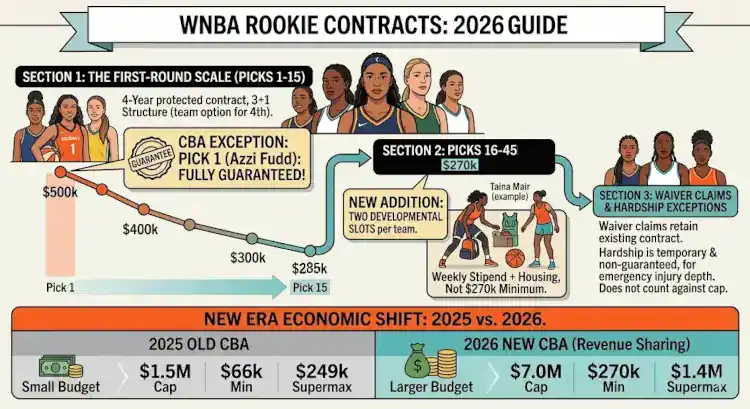
The 2026 season marks the beginning of a new financial era for the WNBA. With the ratification of the current Collective Bargaining Agreement (CBA), rookie contracts have shifted from modest entry-level deals to high-value professional agreements. Understanding the “Rookie Scale” is essential for tracking how teams manage their rosters under the new $7 million salary cap.
The New Era: 2025 vs. 2026
The current CBA introduced a revenue-sharing model that significantly increased both team caps and individual salaries. This jump represents the largest single-year economic shift in league history.
| Feature | 2025 Season (Old CBA) | 2026 Season (New CBA) |
| Team Salary Cap | $1,507,100 | $7,000,000 |
| No. 1 Pick Status | Non-Guaranteed | Fully Guaranteed |
| Min. Rookie Salary | $66,000 | $270,000 |
| Min. Vet Salary (3+ yrs) | $78,831 | $300,000 |
| Regular Max Salary | $214,466 | $1,190,000 |
| Supermax Salary | $249,244 | $1,400,000 |
Why the Scale is Fixed
The WNBA uses a “Hard Scale” to ensure competitive balance. By fixing rookie wages, the league prevents expansion teams or large-market franchises from “overpaying” for rookies and depleting their cap.
First-Round Security: Picks 1 through 15 are the primary focus of a team’s cap management. Because these players represent a significant investment, they are heavily prioritized for rotation spots.
The Second and Third Round Battle: For picks 16 through 45, the salary is the same across the board ($270,000). For these players, the contract is essentially an invite to training camp. They only receive this salary if they successfully secure one of the 12 active roster spots or one of the two new developmental slots.
Perspective Check: The $270k minimum for a 3rd rounder in 2026 is higher than the Supermax was just one year ago. This puts the “New Era” economics into stark perspective.
How Long Are 2026 WNBA Rookie Contracts?
WNBA rookie contracts are structured to give teams control over young talent while providing players a clear path to veteran free agency.
The 3+1 Structure: First-round picks (1–15) sign four-year contracts.The first three years are protected, while the fourth year is a team option. Teams must decide whether to exercise this option by May 15 of the player’s third season.
The Guarantee Rule: Starting in 2026, the No. 1 overall pick is the only rookie contract that is fully guaranteed from day one. For all other picks, the contract only becomes fully protected once the player makes the final roster.
Later Rounds: Second- and third-round picks typically sign one-year, non-guaranteed contracts. These are effectively “audition” deals; the team can release the player at any time during training camp without a cap penalty.
Section 1: How Much Do WNBA Rookies Make? (2026 First Round Scale)
The No. 1 overall pick receives a historic guaranteed scale, while the remaining picks follow a tiered structure based on draft slot.
| Pick | Player | Team | 2026 Base Salary |
| 1 | Azzi Fudd | Dallas Wings | $500,000 (Guaranteed) |
| 2 | Olivia Miles | Minnesota Lynx | $466,913 |
| 3 | Awa Fam | Seattle Storm | $436,016 |
| 4 | Lauren Betts | Washington Mystics | $407,151 |
| 5 | Gabriela Jaquez | Chicago Sky | $385,000 |
| 6 | Kiki Rice | Toronto Tempo | $375,000 |
| 7 | Iyana Martín Carrión | Portland Fire | $365,000 |
| 8 | Flau’jae Johnson | Golden State Valkyries | $355,000 |
| 9 | Angela Dugalić | Washington Mystics | $345,000 |
| 10 | Raven Johnson | Indiana Fever | $335,000 |
| 11 | Cotie McMahon | Washington Mystics | $325,000 |
| 12 | Nell Angloma | Connecticut Sun | $315,000 |
| 13 | Madina Okot | Atlanta Dream | $305,000 |
| 14 | Taina Mair | Seattle Storm | $295,000 |
| 15 | Gianna Kneepkens | Connecticut Sun | $285,000 |
WNBA Draft: Essential Fan Resources
Now that you understand the process, here are the best ways to follow the action and support the next class of stars.


Watch from Home
Watch the WNBA Live on Prime Video
Section 2: The Developmental Roster Spots
A major addition to the 2026 CBA is the introduction of two developmental roster spots per team. This allows franchises to keep promising young talent in the system without them counting against the active 12-player roster limit.
The Scale: Developmental players receive a weekly stipend and housing rather than the full $270k active minimum. If they are “activated” for a game, they earn a pro-rated portion of the rookie minimum for that day.
The Mechanic: These players practice and travel with the team, allowing them to develop within a pro system while the team maintains their exclusive rights.
Examples: Justine Pissott (Indiana) and Darianna Littlepage-Buggs (Washington) were signed directly to these slots. Taina Mair provides a unique 2026 example: after being waived by Seattle on May 4, she cleared waivers and was re-signed to a Player Development Contract on May 6.
Section 3: Waiver Claims & Training Camp Contracts
For undrafted free agents or late-round picks, the contract is an “invitation to compete.” These agreements are non-guaranteed and only become active if the player makes the final roster or is claimed by another team.
Waiver Claims: If a player is waived, other franchises have 48 hours to claim their existing contract. A recent example is Hailey Van Lith, who was waived by Chicago on May 4 but was immediately claimed by the Connecticut Sun on May 6, taking over her original rookie scale deal.
Hardship Exceptions: If a team deals with multiple injuries and falls below 10 healthy players (even after activating their two Developmental Players), the league may grant a Hardship Exception. This allows the team to sign a free agent to a temporary contract that lasts only until the injured player returns.
Section 4: Roster Mechanics & The Hard Cap
The modern WNBA roster is composed of 12 Active Players and 2 Developmental Players. Even with a $7 million cap, the league remains a “hard cap” system. Teams must balance $1.4 million Supermax deals with the fixed rookie scale, forcing front offices to decide between experienced depth and the cost-controlled potential of new draftees.
Note on the New Era: Curious how the rookie scale looked before the 2026 reset? Check out our 2025 Rookie Contract Archive to compare the scales.
Helpful Links
- WNBA training camps open today! Here’s a look at all 15 rosters and more
- WNBA developmental roster spots ‘an interesting new scenario.’ Why Fever named draft pick to one
- WNBA and Players Union Reach Historic New CBA Agreement
- WNBA, players’ union meet for three hours in ongoing CBA negotiations
- What Would New WNBA Salaries Look Like in 2026?
📖 This is part of our WNBA Draft 101 series.


