WNBA Rookie Report: Year-End Review of the 2026 Class
The 2026 WNBA season is in the books, providing a complete 44-game sample size to evaluate this year’s rookie class. From record-setting point guards to physically imposing frontcourt presences, these first-year players immediately shaped the playoff race and shook up depth charts.
While some draft picks assumed heavy minutes from opening night, others maximized limited off-the-bench roles or utilized new CBA mechanisms to secure standard contracts. We break down the on-court production, statistical milestones, and overall impact for every team’s draft class.
Atlanta Dream
🔗 Read the Atlanta Dream Draft Tracker here
Isobel Borlase and Madina Okot established themselves as reliable second-unit contributors. Okot showcased remarkable efficiency around the basket, shooting 58% from the floor while pulling down 3.4 rebounds in roughly 9 minutes of action per night. In the backcourt, Borlase finally made her WNBA debut two years after being drafted in 2024. She took excellent care of the ball and provided steady production, shooting 43% from the field.
Chicago Sky
🔗 Read the Chicago Sky Draft Tracker here
For the second consecutive season, 2025 first-round pick Ajša Sivka deferred her rookie debut; after staying overseas last year, she has now committed to play at Kentucky while Chicago retains her rights.
Sydney Taylor authored one of the most compelling rookie arcs of the year. After being the final player to secure an active roster spot out of training camp, Taylor shot her way into the starting lineup by mid-season. She delivered perimeter scoring and fearless shotmaking, punctuated by a clutch game-winner against the Las Vegas Aces to solidify her rotation role.
Gabriela Jaquez opened her debut campaign strong, providing wing depth and a relentless motor on both ends. An early injury halted that initial momentum, and she struggled to find consistent minutes once back at full strength. She rebounded with a strong late-season surge, scoring in double figures in three of her final four contests.
Aicha Coulibaly completed a long road to her WNBA debut after missing 2025 with a torn ACL. Signed to a developmental contract under the league’s new CBA rules, the athletic wing provided energetic defense and transition scoring in spot duty. Her impact earned her a rest-of-season standard contract before the turn of July.
Connecticut Sun
🔗 Read the Connecticut Sun Draft Tracker here
Charlisse Leger-Walker proved to be a second-round steal. She provided immediate backcourt stability, eventually playing her way into the starting lineup for 32 of her 44 appearances and finishing second among all rookies with 160 assists. Conversely, Gianna Kneepkens faced a steep transition to the professional level, struggling to create separation for her shot and finding difficulty staying in front of assignments on the defensive end.
In the frontcourt, Raegan Beers served as a rookie revelation. She maximized her limited rotation minutes, capitalizing on her touches to shoot 49.2% from the floor. Ashlon Jackson also made an impact after signing a developmental contract, coming on strong down the stretch by knocking down multiple three-pointers in three of her final four games. Rounding out the class, Nell Angloma remains a raw developmental project but possesses a ton of long-term upside as a highly athletic wing.
Dallas Wings
🔗 Read the Dallas Wings Draft Tracker here
It took a few games for Azzi Fudd to crack the starting lineup, but once she did, Dallas’ offense hit its stride. The No. 1 overall pick lived up to her billing as an elite scoring threat, shooting an efficient 45.6% from the floor and 39.7% from three-point range. Fudd also showcased her ability to heat up offensively, highlighted by a career-high 26-point performance in an overtime win against Seattle and a scorching stretch where she buried 4-of-5 threes in just 24 minutes against Connecticut. Unfortunately, her promising rookie campaign was cut short in mid-August when she was shut down for the remainder of the season and the playoffs to undergo an arthroscopic procedure on her right knee.
Golden State Valkyries
🔗 Read the Golden State Valkyries Draft Tracker here
After deferring her 2025 season, Justė Jocytė finally arrived in the Bay Area and made her highly anticipated debut. While the 20-year-old Lithuanian wing played sparingly on a deep, contending roster, she flashed her immense potential in her limited minutes. Jocytė showcased a smooth, poised offensive game and connected on 42.3% of her three-point attempts. Though her playing time was limited to 16 appearances, her smooth jumper and high basketball IQ suggest she could be a key piece in Golden State’s future.
Fan Hub
This post may contain affiliate links. Please read the disclosure policy.



Indiana Fever
🔗 Read the Indiana Fever Draft Tracker here
Raven Johnson and Grace VanSlooten were the notable rookies for Indiana, though both barely played behind an established rotation. When she did see the floor, Johnson showed flashes of her signature two-way game, bringing stellar perimeter defense and sharp playmaking. She notably dished out a career-high seven assists during a tight two-point loss to the Phoenix Mercury. VanSlooten, who was scooped up by the Fever in late May to a standard contract after being waived by Seattle, provided frontcourt depth but similarly saw very limited action over the course of the season.
Las Vegas Aces
🔗 Read the Las Vegas Aces Draft Tracker here
While Mai Yamamoto was the only rookie to see consistent rotation minutes, she maximized her opportunity. She quickly became a fan favorite, providing a reliable spark off the bench and shooting 38% from three-point range.
The Aces also bolstered their depth by grabbing Justine Pissott and Ta’Niya Latson from other organizations. After being converted to a standard contract, Pissott made an immediate splash in her Las Vegas debut, erupting for 17 points. Latson rounded out the rookie group, spending the remainder of the season as a developmental player.
Los Angeles Sparks
🔗 Read the Los Angeles Sparks Draft Tracker here
While the Sparks initially drafted Ta’Niya Latson, she struggled to find consistent footing and was ultimately waived mid-season. Chance Gray served as the team’s most consistent rookie presence. She flashed promise in her limited minutes by providing pesky defense and reliable deep shooting.
Los Angeles also bolstered its depth by picking up Tonie Morgan and Ndjakalenga Mwenentanda on developmental contracts. Mwenentanda was a late-August addition who barely saw the floor, but Morgan’s downhill speed and athleticism earned her a full standard contract by mid-August. She capitalized on her opportunities, dropping a career-high 14 points against the Aces in the final week of the season.
Minnesota Lynx
🔗 Read the Minnesota Lynx Draft Tracker here
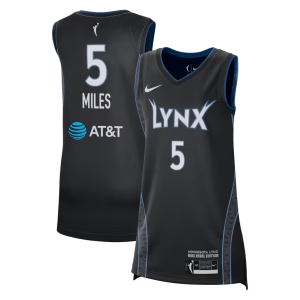
For the number one overall seed Lynx, Olivia Miles is undeniably the story of the year. The runaway Rookie of the Year led Minnesota’s offensive charge with a staggering 19.8 points, 4.7 rebounds, and 6.0 assists per game. Putting up historic rookie numbers, Miles showcased elite efficiency across the board, shooting 49.2% from the floor, 38.8% from three, and 87.0% from the free-throw line. She immediately translated her college dominance into professional superstardom.
Rounding out Minnesota’s rookie class, Emma Čechová was enjoying a highly promising debut season before suffering a season-ending ACL tear. Additionally, Antonia Delaere made the most of her limited opportunities; the Belgian wing provided excellent efficiency in just under 12 minutes per game, shooting 45.7% from the field and 41.9% from deep.
New York Liberty
🔗 Read the New York Liberty Draft Tracker here
Pauline Astier proved to be a revelation in the backcourt. After stepping into the starting lineup due to early-season injuries to New York’s guards, the French rookie never relinquished her spot. She ended up starting 39 of her 44 appearances, delivering both timely shooting and steady playmaking.
The Liberty also brought over fellow French guard Marine Fauthoux. She initially began the year as a developmental player, acclimating to the WNBA pace in limited action off the bench. Her progress eventually paid off, as New York signed her to a multi-year standard contract by August.
Phoenix Mercury
🔗 Read the Phoenix Mercury Draft Tracker here
Jovana Nogic opened the year playing quite well in the backcourt before she asked to be released mid-season to play overseas. Noémie Brochant was the team’s most notable rookie, starting 33 of her 43 appearances and providing steady floor spacing while shooting 37% from deep.
Phoenix also found value in the developmental player pool. Marta Suárez, who was initially drafted by the Valkyries, eventually found a home as a developmental player for the Mercury. The team also brought in Shay Ciezki as another developmental player, with the undrafted guard making the most of her late-season opportunities to secure a rest-of-season contract.
Portland Fire
🔗 Read the Portland Fire Draft Tracker here
Nyadiew Puoch provided essential frontcourt minutes for the new franchise. Originally selected in the 2024 WNBA Draft, she was acquired by Portland in the expansion draft and stepped into the rotation to start 28 of her 42 appearances. While she averaged just 4.3 points per game, she brought length and defensive versatility to the starting unit.
The Fire also found considerable value in their developmental players. Frieda Bühner was initially signed to a developmental contract, but her natural scoring and shooting instincts quickly earned her a conversion to a standard deal early in the season. Jordan Harrison followed a similar path; the undrafted guard provided tenacious point-of-attack defense and earned a standard WNBA contract of her own by early August. Former college star Serah Williams also carved out minutes off the bench to provide essential depth for the expansion team. Finally, rounding out the rookie group, Charisma Osborne was picked up late in the season on a developmental contract and quickly made the most of her opportunities, averaging 9.7 points and shooting 50% from three across her three appearances.
Seattle Storm
🔗 Read the Seattle Storm Draft Tracker here
Awa Fam showed impressive flashes of her versatile game throughout her rookie campaign. The 20-year-old Spanish center averaged 10 points and nearly two assists per game, while also proving capable of stretching the floor by shooting 35% from three-point range.
Despite the Storm finishing in last place, Flau’jae Johnson was a consistent bright spot, slicing and dicing her way through opposing defenses to average nearly 15 points per contest. Taina Mair is also a promising prospect; she was initially Seattle’s first-round pick before being waived and later picked back up on a developmental contract. With second-year center Dominique Malonga already earning an All-Star nod at just 20 years old, she anchors a young, long, and athletic core that should have Seattle perfectly positioned for the future.
Toronto Tempo
🔗 Read the Toronto Tempo Draft Tracker here
Kiki Rice proved to be the expansion franchise’s most notable rookie, establishing herself as arguably the second-best rookie in the entire class behind Olivia Miles. Despite missing 19 games in the middle of the season, she returned seamlessly and picked up exactly where she left off. The first-round pick put together an impressive debut campaign by consistently slicing her way into the paint and showcasing a highly reliable jumper, averaging 13.4 points, 3.7 rebounds, and 3.5 assists to highlight a well-rounded game.
The Tempo also received strong contributions from their international additions. Laura Juškaitė stepped into the rotation to start 36 of her 44 appearances, providing steady floor spacing and outside shooting as a 6-foot-4 stretch forward. María Conde also made a clear impact with her versatile game, doing a little bit of everything on the floor before being shut down at the end of the year. Rounding out the rookie group, Teonni Key saw limited action off the bench but remains a promising prospect with tangible defensive upside.
Washington Mystics
🔗 Read the Washington Mystics Draft Tracker here
The Mystics fielded the youngest team in the league, carrying a whopping eight rookies on the roster. Georgia Amoore, originally drafted in 2025, made her official debut this season after missing last year with a torn ACL. She started all 44 games, though her rookie campaign was a bit up and down. Her shooting was streaky, and she struggled at times to stay in front of players defensively, but she still helped lead Washington to a franchise-record win total.
Cotie McMahon had a solid rookie season, operating as a freight train in transition to provide impactful minutes off the bench. Lauren Betts was also an impactful reserve, leading all rookies in blocks to anchor the interior for the playoff-bound Mystics. Further down the rotation, Angela Dugalić and Alicia Flórez saw limited minutes but provided steady depth. Cassandre Prosper showed flashes as a raw but long and athletic forward with 3-and-D potential, while Darianna Littlepage-Buggs and Rori Harmon rounded out the massive rookie class as developmental players with promise.
Securing the fifth seed, this young Mystics core is playing its best basketball at exactly the right time. With so much rookie talent already contributing to a playoff run, the foundation is set, and the best is clearly yet to come in Washington.
Final Thoughts
With the regular season officially in the books, this draft class has firmly established itself as a transformative group.
At the top of the class, Minnesota’s Olivia Miles emerged as the clear Rookie of the Year favorite, while top picks like Toronto’s Kiki Rice and Dallas’s Azzi Fudd proved their collegiate scoring and playmaking translated directly to the professional level.
Beyond the expected stars, the depth of the class was defined by its under-the-radar success stories. Chicago’s Sydney Taylor fought her way from a training camp invite to become a bright spot in the Sky’s season, while lesser-known players like Portland’s Frieda Bühner and New York’s Pauline Astier already look to be long-term pieces for their respective franchises. From Connecticut’s Charlisse Leger-Walker stepping up to start 32 games to the young upstart Washington Mystics securing the fifth seed by getting high-impact minutes from their rookies, the 2026 WNBA rookies made an undeniable impact across the entire league.
📲 Want the full breakdown for each team? Check out the individual team pages!
Helpful Links