WNBA Draft Battleground: Hannah Stuelke vs. Serah Williams

The Series: WNBA Draft Battleground

hannah stuelke wnba draft

In this series, we go toe-to-toe with the toughest evaluations in the 2026 class. In each installment, we take two prospects with similar profiles, pit them against each other, and answer the ultimate question: Who projects as the better pro?

Round 2: Hannah Stuelke vs. Serah Williams

Round 2 features two productive forwards, Iowa’s Hannah Stuelke and UConn’s Serah Williams. They are not “stretch-bigs”—they are traditional post players who do their work in the paint.

They share a similar offensive profile: effective rim running and interior play, with limited shooting range. Neither player looks to hunt the 3-point shot; they make their living in the restricted area.

The difference lies in how they dominate that space. Stuelke is the speedster who runs the floor like a wing, while Williams is more of a traditional big with an array of post moves. The question for scouts: Do you bet on the elite open-court athlete or the more polished interior anchor?

We breakdown the matchup:

Prospect Profile: Hannah Stuelke

The Case For

Speed: Stuelke consistently beats opposing players downcourt for easy buckets, utilizing a second gear that most post players simply do not possess.

Finishing Efficiency: She is an efficient scorer who stays within her strengths. Stuelke shoots nearly 60% from the field because she relentlessly attacks the rim.

Motor: Lacking elite height, she compensates with a good motor. Her second jump allows her to keep plays alive on the offensive glass, generating extra possessions.

The Case Against

The “Tweener”: At 6’2″ with no reliable 3-point shot (career <25% from deep), she is stuck between positions. She lacks the size to defend WNBA centers but hasn’t proven she can space the floor as a true forward.

Fan Hub

This post may contain affiliate links. Please read the disclosure policy.

As one of the top names to watch for in the 2026 WNBA Draft, her journey is happening right now. Track the next generation of talent and see a future pro in the making.

Rep Her College Colors: Before she gets to the WNBA, she’s a star for her university. This is the best place to find all the officially licensed gear for her team.

Get on Board: Get the “Everyone Watches Women’s Basketball” Hoodie. 

Rep Your Hawkeyes with the Basketball Icon Crewneck
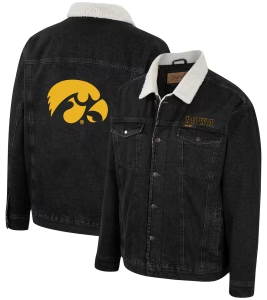
Fan Gear Drop - "Iowa Hawkeyes Wrangler Western Denim Jacket"

Prospect Profile: Serah Williams

The Case For

Post Play: Williams is an effective interior scorer with a variety of moves. She does most of her work in the paint, with reliable spin moves, drop steps, and short jumpers.

Size: At 6’4″, she has the requisite frame to play the traditional 5 at the next level. Unlike Stuelke, she doesn’t need to be an outlier athlete to survive inside; her physical profile is WNBA-standard.

Defensive Anchor: Williams is a proven rim protector, having won Big Ten Defensive Player of the Year (2024) at Wisconsin before transferring to UConn. She has the timing and length to erase mistakes and anchor a defense.

The Case Against

Limited Spacing: Like Stuelke, she is not a floor spacer. She rarely attempts threes (averaging fewer than 0.5 attempts per game).

Hannah Stuelke (Iowa) Serah Williams (UConn) Advantage
Height 6'2" 6'4" Williams
Draft Age 22 22 ---
Athleticism Elite speed; runs like a wing Good mobility Stuelke
Shooting Paint Only Paint / Mid Williams
Defense Switchable Proven Rim Protector Williams
Post Skills Face-up drives / Athletic finishes Traditional: Drop steps / Spins Williams
Upside Energy Big / Transition Specialist Impact Center Williams
WNBA Readiness Rotational (Energy/Motor) Developmental (Offensive Adjustment) Stuelke

The Verdict: Who Projects as the Better Pro?

The Winner: It’s a Tie? (Dependant on Team Needs)

This matchup ends in a split decision because the two players serve completely different timelines.

On paper, Serah Williams wins this battle. She checks nearly every box: she has the size, defense, and post polish that Stuelke lacks. However, her early struggles at UConn have exposed a concern: she is not as impactful when she isn’t the focal point. To be effective, she needs rhythm and consistent post touches—luxuries that rookies rarely get in the WNBA.

However, games aren’t played on paper. Hannah Stuelke is the player who pops on film. Her elite motor and transition speed allow her to impact a game immediately without needing plays called for her. She can be a high-energy rotational piece, whereas Williams faces a steeper learning curve to adjust to a lower-usage role.

Final Call:

Draft Williams if: A team has a developmental plan and needs a defensive anchor for the future.

Draft Stuelke if: A team needs an immediate jolt of energy and transition scoring off the bench right now.

You're on the clock. Who do you draft?

Rate this take on Stuelke vs. Williams.

Stream Big 12, ACC & SEC games on ESPN, ESPN2, ACCN, SECN, ESPN+ & more. Includes Disney+ and Hulu. All for 29.99/mo.

WNBA Draft Battleground: Olivia Miles vs. Kiki Rice

The Series: WNBA Draft Battleground

olivia miles wnba draft

In this series, we go toe-to-toe with the toughest evaluations in the 2026 class. In each installment, we take two prospects with similar profiles, pit them against each other, and answer the ultimate question: Who projects as the better pro?

Round 5: Olivia Miles vs. Kiki Rice

This matchup features arguably the top two point guards in the 2026 WNBA Draft class.

They share the same elite physical profile: big guards and unselfish playmakers who do a little bit of everything to impact winning.

But their approaches couldn’t be more different. One dominates with flash and open-court creativity; the other excels with reads and precision.

We break down the matchup ⬇️

Prospect Profile: Olivia Miles

The Case For

The “It” Factor: Olivia Miles possesses a level of passing creativity that cannot be taught. She doesn’t just find open teammates; she creates them with stellar court vision and manipulation. Currently averaging 20.2 points, 6.8 rebounds, and 6.6 assists, she orchestrates the TCU offense with a flair that makes her dangerous in the open court.

Offensive Engine: Her ability to decelerate, change pace, and whip passes all over the court allows her to dismantle defenses. After missing the 2023-24 season, she has returned not just healthy, but with a refined jumper. While her 3-point efficiency has dipped slightly (36.3%, down from 40.6%), it remains a significant improvement over her pre-injury numbers (22.8%).

The Case Against

Turnover Prone: Miles plays a high-risk game, often attempting home-run passes when a single was available. In the WNBA, those live-ball turnovers will be punished.

Defense: While she has quick hands and gets steals at a high rate (1.9 spg), she can be too upright in her stance and often gets caught ball-watching rather than staying attached to her matchup. At both Notre Dame and now TCU, Miles has been benched in critical late-game defensive possessions—a concerning trend for a team’s best player.

Fan Hub

This post may contain affiliate links. Please read the disclosure policy.

As one of the top names to watch for in the 2026 WNBA Draft, her journey is happening right now. Track the next generation of talent and see a future pro in the making.

Rep Her College Colors: Before she gets to the WNBA, she’s a star for her university. This is the best place to find all the officially licensed gear for her team.

Get on Board: Get the “Everyone Watches Women’s Basketball” Hoodie. 
Shop Hoodies >
Shop Apparel >
Get Event Bag >

Prospect Profile: Kiki Rice

The Case For

Floor General: Kiki Rice operates with the poise of a veteran. Her game is methodical and calculated. While her raw assist numbers are slightly down, the context is crucial: she shares the backcourt with Charlisse Leger-Walker, a four-year star and All-Pac-12 performer. Leger-Walker leads the Bruins with 5.5 assists per game, effectively shifting Rice into a secondary playmaking role. This proves Rice can thrive without being ball-dominant—a massive plus for WNBA teams with established stars.

Physical Profile: At 5’11”, Rice is built for WNBA physicality. She is an excellent rebounder who’s not afraid to mix it up in the paint. Defensively, she is a scrappy, solid defender who stays in front of her woman.

The Case Against

Lack of “Takeover” Mode: Rice is so unselfish that she can sometimes defer to a fault, content to blend into the flow of the offense. For someone of Rice’s pedigree, she is a bit of an enigma. She has the tools and the hype, but that lack of an alpha mentality makes you wonder: For someone expected to be a lottery pick in the 2026 WNBA Draft, does she have the takeover DNA required to be a franchise cornerstone?

Olivia Miles (TCU) Kiki Rice (UCLA) Advantage
Height 5'10" 5'11" Tie
Draft Age 23 22 Tie
Athleticism Shifty; elite deceleration Strong; downhill force Rice
Shooting 3-Level Scorer (improved 3PT) Mid-range & Rim specialist Miles
Defense High steals; Gambles/Upright Scrappy defender Rice
Decision Making Visionary: Flashy (High Risk/Reward) Cerebral: Methodical (Low TOs) Miles
Upside Franchise Cornerstone Championship Piece Miles
WNBA Readiness Immediate Developmental Miles

The Verdict: Who Projects as the Better Pro?

If you draft Kiki Rice, you are getting a player who projects as a solid pro. She will defend, she will rebound, and she will never lose you a game with a bad decision. She is the safe, smart, winning pick.

If you draft Olivia Miles, you are swinging for a Superstar.

The WNBA is a league of stars. You can find steady point guard play in free agency; you cannot find Olivia Miles’ vision on the open market. Her ability to see plays before they happen gives her a gravitational pull that changes how defenses guard your entire team.

Rice fits any roster. Miles will define the roster.

At the top of the draft where you need to find a franchise-changer, you take the player with the magic.

Winner: Olivia Miles

Final Call: Miles wins the matchup.

Do you draft for magic or for safety? Who is the better long-term pick?

Rate this take on Miles vs. Rice.

Stream Big 12, ACC & SEC games on ESPN, ESPN2, ACCN, SECN, ESPN+ & more. Includes Disney+ and Hulu. All for 29.99/mo.

WNBA Draft Battleground: Maggie Doogan vs. Gianna Kneepkens

The Series: WNBA Draft Battleground

maggie doogan wnba draft

In this series, we go toe-to-toe with the toughest evaluations in the 2026 class. In each installment, we take two prospects with similar profiles, pit them against each other, and answer the ultimate question: Who projects as the better pro?

Round 4: Maggie Doogan vs. Gianna Kneepkens

Round 4’s matchup of late first round talents brings a little history:

Last summer, both were finalists for the USA AmeriCup team. Gianna Kneepkens made the roster; Maggie Doogan was one of the final cuts.

Now, they are competing for draft positioning. On paper, they share the same elite DNA: pure shooters chasing the coveted 50/40/90 split.

But one is more proven, having played in the Pac-12, Big 12, and now Big Ten. The other plays in a mid-major conference, the Atlantic 10.

We break down the matchup ⬇️

Prospect Profile: Maggie Doogan

The Case For

Physical Versatility: Doogan looks like the modern prototype. At 6’2″, she possesses the length of a forward but the fluid movement of a guard. She is an elite cutter who understands spacing and uses her height to shoot over smaller defenders.

Elite Efficiency: Despite carrying a massive offensive load for Richmond, Doogan is flirting with a 50/40/90 season (51/43/87). She isn’t just a volume scorer putting up empty stats. Her ability to maintain that efficiency while leading Richmond in scoring, rebounds, assists, and blocks – while also being the primary focus of every defense suggests her shooting stroke is translatable to the next level.

Big Game Resume: After dropping 27 points, 7 rebounds and 6 assists against UCLA in last year’s Sweet 16, she continued her stellar play against top competition with big outings against Texas and TCU this season, serving as proof that her skill set works against WNBA-level length and athleticism.

The Case Against

Level of Competition: The “Mid-Major” stigma is real. While her production is undeniable, she faces significantly weaker defenders on a night-to-night basis in the A-10 compared to the Power 4 conferences.

Sample Size: Doogan has only played a handful of games against elite competition. Drafting her is a bet that her standout performances against Power 4 schools were the rule, not the exception. If she struggles to separate against pro-level athletes consistently, it lowers her ceiling.

Fan Hub

This post may contain affiliate links. Please read the disclosure policy.

As one of the top names to watch for in the 2026 WNBA Draft, her journey is happening right now. Track the next generation of talent and see a future pro in the making.

Rep Her College Colors: Before she gets to the WNBA, she’s a star for her university. This is the best place to find all the officially licensed gear for her team.

Get on Board: Get the “Everyone Watches Women’s Basketball” Hoodie. 

Shop Hoodies >
Shop Event Bags >
Shop T-Shirts >

Prospect Profile: Gianna Kneepkens

The Case For

Proof of Concept: Kneepkens offers immediate certainty. Having played in the Pac-12, Big 12, and now Big Ten, she has four years of film scoring on future WNBA defenders. She has proven she can scale her game, seamlessly transitioning from the primary option at Utah to superb role player to stars at UCLA, which is the exact role she will play as a rookie.

Shooting: Kneepkens is one of the premier shooters in the class. With current splits of 53/48/95, she provides elite spacing. She plays with a “throwback” pace, using hesitation dribbles and an unorthodox but deadly shot.

The Case Against

Athletic Ceiling: Kneepkens lacks elite burst and top-end speed. She relies on craftiness and angles rather than blowing by defenders. In the WNBA, where the athleticism jumps a level, there are questions about whether she can create her own shot or if she will be limited strictly to a spot-up role.

Defensive Versatility: While she is a smart team defender, she may struggle to stay in front of WNBA guards. Her lack of lateral quickness could make her a target for opposing offenses.

Maggie Doogan (Richmond) Gianna Kneepkens (UCLA) Advantage
Height 6'2" 6'0" Doogan
Draft Age 22 23 Doogan
Athleticism Good length; fluid mover Smooth pace; average burst Doogan
Shooting Ascending: 41% ➔ 43% (Last 2 Yrs) Proven: 45.4% 3PT (4-year sample) Kneepkens
Defense Disruptive length; Shot blocking Scrappy defender Tie
Decision Making Creative: High usage (4.0 TOs) Disciplined: Steady hand (1.3 TOs) Kneepkens
Upside Starter Role Player Doogan
WNBA Readiness Developmental (Role adjustment) Immediate Kneepkens

The Verdict: Who Projects as the Better Pro?

On paper, this is a deadlock.

Both Doogan and Kneepkens are elite offensive players who rely on IQ and efficiency rather than explosive athleticism. Both will likely face the same questions about their lateral quickness and defensive ceiling at the pro level.

But when the skill sets are this similar, the tiebreaker goes to Measurables.

Maggie Doogan is two inches taller with a quicker release.

Those physical advantages matter. WNBA shooting windows are razor-thin. Doogan’s length and quicker release allows her to shoot over defenders, granting her a greater margin for error than for Kneepkens.

Drafting Kneepkens is the safe play. But if you are betting on who has the better pro career, you bet on the player with the physical upside that cannot be taught.

If you need a player who helps you win tomorrow, you take Kneepkens. If you need a versatile forward who could be a steal in three years, you take Doogan.

Winner: Maggie Doogan

Final Call: Doogan wins this matchup by a hair.

Both are elite shooters with limited athleticism. Who projects as the better pro?

Rate this take on Doogan vs. Kneepkens.

Stream Big 12, ACC & SEC games on ESPN, ESPN2, ACCN, SECN, ESPN+ & more. Includes Disney+ and Hulu. All for 29.99/mo.

WNBA Draft Battleground: Rori Harmon vs. Raven Johnson

The Series: WNBA Draft Battleground

rori harmon wnba draft

In this series, we go toe-to-toe with the toughest evaluations in the 2026 class. In each installment, we take two prospects with similar profiles, pit them against each other, and answer the ultimate question: Who projects as the better pro?

Round 3: Rori Harmon vs. Raven Johnson

Texas’s Rori Harmon and South Carolina’s Raven Johnson are defensive point guards: “pass-first” floor generals who prioritize setting the table over hunting their own shot. Both are absolute pests on the defensive end. And both face the same major question mark: Can they impact the game enough to make it in the WNBA?

Mock drafts have both players all over the map. Harmon is projected anywhere from a lottery talent to a mid-second rounder, while Johnson fluctuates from late first round to third round. W Bound has Harmon slotted as a second-rounder, while Johnson is a late pick in the third round—barely edging out of “undrafted” territory.

The WNBA is notoriously difficult for undersized non-scoring guards. Teams need ball-handling depth, but are wary of guards who can be ignored by defenses.

We breakdown the matchup:

Prospect Profile: Rori Harmon

The Case For

Point-of-Attack Defense: Harmon’s best trait is her on-ball defense. Her lateral quickness is elite; she doesn’t just stay in front of ball handlers, she terrorizes them, having earned Big 12 Defensive Player of the Year honors by generating steals and deflections that fuel transition offense.

The Mid-Range Game: Unlike many small guards who struggle to score inside the arc, Harmon has a lethal pull-up jumper. She is comfortable operating in the pick-and-roll and punishing drop coverage with a reliable 15-footer, giving her a go-to scoring option when the play breaks down.

Tempo Control: Texas plays at Rori Harmon’s speed. Her assist-to-turnover ratio has historically been among the nation’s best (even leading the country in A/T ratio in 2023-24, before her injury), meaning she runs a high-speed offense without making critical mistakes.

The Case Against

Size & Durability: Listed at 5’6”, she is undersized for the modern WNBA. Combined with her frantic playstyle and history of injuries (most notably a torn ACL in the 2023-24 season), there are legitimate concerns about her body holding up against WNBA physicality.

3-Point Volume: Defenses frequently go under screens against her. While she can hit open shots, she is a reluctant 3-point shooter, allowing defenders to sag off and clog the paint.

Fan Hub

This post may contain affiliate links. Please read the disclosure policy.

As one of the top names to watch for in the 2026 WNBA Draft, her journey is happening right now. Track the next generation of talent and see a future pro in the making.

Rep Her College Colors: Before she gets to the WNBA, she’s a star for her university. This is the best place to find all the officially licensed gear for her team.

Get on Board: Get the “Everyone Watches Women’s Basketball” Hoodie. 

Show Your Colors with the "Texas Longhorns Fanatics Team Hoodie"
Cap Off with the "Texas Longhorns Nike Throwback Adjustable Hat"
Get Your Swagger on with the "Texas Women's Vintage T-Shirt"

Prospect Profile: Raven Johnson

The Case For

Size: Though still a bit undersized for a WNBA guard, Johnson’s long wingspan allows her to switch onto larger wings.

Defensive Versatility: She famously shut down Caitlin Clark in the 2024 NCAA Tournament title game. Johnson isn’t just a pest; she is a lockdown defender capable of erasing an opponent’s best perimeter option.  

Championship DNA: She is a “winner,” having led South Carolina to multiple titles. She knows her role, moves the ball, and makes high-IQ reads—exactly the type of low-maintenance floor general coaches love to have running a second unit.  

The Case Against

Scoring Aggression: Johnson can be passive to a fault. There are stretches where she refuses to look at the rim (averaging fewer than 6 field goal attempts per game for her career).

Finishing at the Rim: She struggles to finish in traffic against length, often opting to kick the ball out rather than challenge rim protectors in the paint.

Rori Harmon (Texas) Raven Johnson (South Carolina) Advantage
Height 5'6" 5'9" Johnson
Draft Age 23 23 ---
Athleticism Elite speed; blur in open court Good length, average quickness Harmon
Shooting Mid-Range: Elite pull-up game Spot-Up: Improving 3PT (40%) Harmon
Defense Generates chaos (3.1 SPG) Switchable Tie
Decision Making Elite A/T ratio High-IQ / Disciplined Harmon
Upside Starter Role Player Harmon
WNBA Readiness Rotational (Change of Pace) Rotational (Defense) Tie

The Verdict: Who Projects as the Better Pro?

The Winner: Rori Harmon

Raven Johnson is the “safe” pick. Her 5’9″ frame and defensive versatility profiles as a high-end backup or defensive specialist in the mold of Briann January. 

However, Rori Harmon is the singular talent in this matchup.

Despite the size concerns, Harmon possesses a trait that cannot be taught: the ability to tilt the entire floor. Her speed breaks defenses, her mid-range shooting punishes drop coverage, and her defensive hands generate easy offense. Players like Jordin Canada and Crystal Dangerfield have proven there is a path for small, dynamic guards to thrive.

Final Call: Harmon wins this matchup.

You're on the clock. Who do you draft?

Rate this take on Harmon vs. Johnson.

Stream Big 12, ACC & SEC games on ESPN, ESPN2, ACCN, SECN, ESPN+ & more. Includes Disney+ and Hulu. All for 29.99/mo.

Discover more from W Bound

Subscribe now to keep reading and get access to the full archive.

Continue reading